The First Gibson Electrics
By the time Gibson began work on its first electric guitar, the company had a 40-year tradition of quality and innovation to uphold. The first Gibson electric had to be nothing less than the best electric guitar the world had ever seen.

In the spring of 1935, Gibson enlisted musician Alvino Rey to help develop a prototype pickup with engineers at the Lyon & Healy company in Chicago. Later that year, research was moved in-house, where Gibson employee Walter Fuller came up with the final design. Gibson introduced the distinctive hexagonal pickup on a lap steel model in late 1935. The pickup was installed on an F-hole archtop guitar, dubbed the ES-150 (ES for Electric Spanish), and the first one shipped from the Gibson factory in Kalamazoo, Michigan, on May 20, 1936.

Was the ES-150 the best electric guitar that guitarists in 1936 had ever seen? Jazz musician Charlie Christian, who would establish the electric guitar as an instrument with its own unique voice, thought so. Sixty years later, the Gibson ES-150 is still known as the Charlie Christian model, and some jazz players consider the ES-150's "Charlie Christian" pickup to be the best jazz pickup ever made.
The ES-150's success was a double-edged sword, establishing Gibson as the foremost maker of electric guitars but at the same time challenging Gibson to top this monumental achievement. After a production break for World War II, Gibson did just that.
Retrieved from http://www.gibson.com/en-us/Support/AboutUs/
Check reviews of these Gibson guitars at Guitar Emporium Online
Guitar/Buying a Guitar
There are two things that hold true, whether you are buying a guitar or an amplifier:
- A guitar that doesn't get played is worthless at any price.
- There is no such thing as bad tone; There are only tones that you may not like.
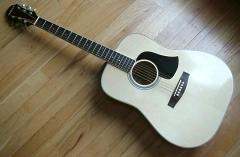
A common six-stringed acoustic guitar.
A guitar is an excellent instrument for almost anyone. A guitar that is difficult to play is not a good choice for a beginner. While it takes dedication to learn, if the guitar is comfortable for the player, it is easier to learn.
Whether you are buying an entry level guitar for yourself or a parent buying a beginner's guitar for a child; it is not worth spending any money on a guitar that the player won't enjoy. How the guitar feels in the player's hands is more important than how it looks hanging up in a store, and the key to learning to play is being excited about playing.
Be careful about buying a guitar for a person that already plays, unless you know exactly what they want. The best course of action is to buy the guitar with the person. Players who have played long enough know what they like and what they don't like. If it is not possible to shop with the guitarist, then the best option is to give them a gift certificate.
Always remember (and this will be obvious after playing a few dozen guitars) every single guitar is different. Even if the guitar is exactly the same make and model and color, it may play completely differently than the next. This is because wood is an organic material and is subject to variation and also the way a shop or manufacturer sets up a guitar may add to the differences. This means in some cases one guitar will be great and another seemingly identical guitar will be a dud.
Retrieved from http://en.wikibooks.org/wiki/Guitar:Buying_a_Guitar
Check these guitars at Guitar Emporium Online
The Squier Story
Fender acquired U.S. guitar string manufacturer the V.C. Squier Company in 1965; by 1982 the Squier name had resurfaced as a low-cost “value brand” alternative initially manufactured and distributed in the Japanese domestic market and soon offered to Europe, North America and the rest of the world.
At the time, many other established brands offered affordable copies of classic Fender models including the Stratocaster®, Telecaster®, Precision Bass® and Jazz Bass® guitars. When Squier versions of these instruments appeared, demand for them as the “official” cost-conscious alternatives was immediate, and a brand name was reborn.
To maintain and control costs over the years, Squier instruments have been produced in several nations, including Japan, Korea, India, China, Indonesia and Mexico. While the brand has produced its share of innovative designs over the past 25 years, its main focus and most successful approach has always been to be the “value brand” alternative to its big brother, Fender.
Retrieved from http://www.squierguitars.com/news/index.php?display_article=99 , 10/07/09
Check these guitars at Guitar Emporium Online
Types of Guitars
Popular Types of Guitars
Acoustic guitar is independent of any external device to be heard. The acoustic guitar is more sober than other instruments commonly found in bands and orchestras. To play within such groups the sound is often externally amplified. Acoustic guitars, which are available today, feature a variety of pickups. This enables the player to increase and adjust the raw guitar sound.
Prominent subcategories feature within the acoustic guitar group
Classical and flamenco guitars; steel string guitars, that comprise the folk or flat top guitar; arch top guitar and the twelve string guitars. There are unamplified guitars also in the acoustic guitar group.
Such types are designed to play in various registers such as the acoustic bass guitar. The tuning of the acoustic bass guitar is similar to that of the electric bass guitar.
Check these guitars at Guitar Emporium Online
How is a guitar constructed?
1. The guitar's body is the large wooden part of the guitar.
2. The thin part of the guitar that is connected to the body of the guitar is called the neck.
3. The bridge is located on the body of the guitar near the hole.
4. The strings of the guitar begin at the bridge and end at the pegs, which is located on the head of the guitar.
5. The head of the guitar is on the end of the neck not connected to the body.
6. There are small metal pieces located at various intervals along the neck of the guitar. These metal pieces are called the frets. When the player presses the strings into the frets at various intervals, the strings vibrate and produce different pitches.
The way you hold the guitar differs for nearly every type of song you play on a guitar. If you are right handed, your right hand is your strumming hand. Thus, you hold your guitar so that your right hand rests on the strings of the guitar above the hole. This means that your left hand is your picking hand, and your left hand should rest on the neck of the guitar. If you are left handed, then you should use these directions as well, only reversed.
Take time to learn the guitar basics and you will be richly rewarded not only with money, but also with a life long relationship with a wonderful instrument.
Electric guitars
Acoustic Bass
Archtop
12-String guitar
Steel-top guitars
Resonator
Many kinds of acoustic guitars
An Introduction to the Types of Guitar
Steel Guitars
Jimmy Hendrix (Fender Tribute)
Electric Guitars
Acoustic electric Guitars
Learn To Play Guitar As Though You Are Learning A New Sport
Learning a new instrument is no different than learning a new sport. With enough practice and the right instruction, anyone can master the skills that are required to perform really well. In fact, learning musical instruments is even easier than sports because they require less natural ability. This means that you can learn to play guitar even if you never believed it possible before.
In addition to those who have never tried to take lessons to play an instrument, there are also people who have tried learning, but have simply not progressed as far as they would have liked. Often this can result in a feeling of failure, or a desire to quit. But before you give into these negative thoughts, there may be a solution so that you can learn to play guitar like the pro that you dreamed of becoming.
With the right education program, anyone can master a skill so long as they are willing to put in the time and effort. The beauty is that with the right program, the time and effort will not even seem like a forced effort.
The difference between the amateur and the professional musician is not as much in their skill or ability, but rather the difference is in their hands. Every instrument requires that the musician have flexible, strong, and agile hands. This is why music and sports are actually very closely related. If you are looking to learn to play guitar or to improve your skills, then you need to work your hands.
We use our hands each and every day, but rarely do we pay much attention to them or how strong they are. People join gyms to work out and build muscles in their arms, legs, and stomach, but few trainers think to address the hands. When you are a musician, your hands are your greatest asset. If you want to learn to play guitar, then you need to start building up the strength of your hands.
Guitar hero Eric Johnson has done it again!
The guitar expert has poured his talents into the Eric Johnson signature electric guitar. Play one riff on the Fender Eric Johnson Stratocaster and you'll be hooked.
Eric Johnson (born August 17, 1954) is an American guitarist and recording artist from Austin, Texas. Best known for his success in the instrumental rock format, Johnson regularly incorporates jazz, fusion, New Age, and country and western music into his recordings.
Guitar Player magazine calls Johnson "One of the most respected guitarists on the planet." Johnson composes and plays not just instrumental songs but also vocal pieces, and plays piano as well as guitar.
Widely recognized for his guitar skills, Johnson's stylistic diversity and technical proficiency have drawn praise from Carlos Santana, Eric Clapton, Allan Holdsworth, Larry Carlton, Steve Morse, Billy Gibbons, Johnny Winter, Jeff Baxter, Prince, B. B. King, Rusty Burns, Joe Satriani and the late Stevie Ray Vaughan. His critically-acclaimed, platinum selling 1990 recording Ah Via Musicom produced the single "Cliffs of Dover," for which Johnson won the 1991 Grammy Award for Best Rock Instrumental Performance.
Eric Johnson is best known for playing stock Fender Stratocaster and Gibson ES-335 electric guitars through a triple amp setup that consists of Fender Amplifiers, Dumble Amplifiers, and Marshall amplification.
C. F. Martin & Company released a limited-edition signature Eric Johnson Signature MC-40 in 2003, built to his specifications. Johnson donated five percent of the profits from his signature Martin guitar to Jefferson Medical College as a tribute to his father who attended.
Fender Musical Instruments Corporation released an Eric Johnson Signature Fender Stratocaster in 2005 also built to his specifications. Johnson has also released other signature gear such as GHS Eric Johnson Nickel Rockers Electric Guitar Strings, DiMarzio DP211 Eric Johnson Signature Custom Pickups, and a Fullton-Webb amplifier. Jim Dunlop also has released an Eric Johnson signature Jazz III plectrum.
More Eric Johnson signature electric guitars...


