There are two things that hold true, whether you are buying a guitar or an amplifier:
A guitar that doesn't get played is worthless at any price.
There is no such thing as bad tone; There are only tones that you may not like.
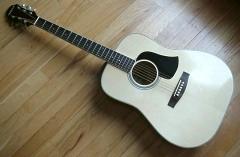
A common six-stringed acoustic guitar.
A guitar is an excellent instrument for almost anyone. A guitar that is difficult to play is not a good choice for a beginner. While it takes dedication to learn, if the guitar is comfortable for the player, it is easier to learn.
Whether you are buying an entry level guitar for yourself or a parent buying a beginner's guitar for a child; it is not worth spending any money on a guitar that the player won't enjoy. How the guitar feels in the player's hands is more important than how it looks hanging up in a store, and the key to learning to play is being excited about playing.
Be careful about buying a guitar for a person that already plays, unless you know exactly what they want. The best course of action is to buy the guitar with the person. Players who have played long enough know what they like and what they don't like. If it is not possible to shop with the guitarist, then the best option is to give them a gift certificate.
Always remember (and this will be obvious after playing a few dozen guitars) every single guitar is different. Even if the guitar is exactly the same make and model and color, it may play completely differently than the next. This is because wood is an organic material and is subject to variation and also the way a shop or manufacturer sets up a guitar may add to the differences. This means in some cases one guitar will be great and another seemingly identical guitar will be a dud.
Guitars are the most common instruments played by many music lovers of all ages. Even kids can easily learn to play the guitar. Choosing the right guitar is very easy. There are many types of guitars that can go along with any kind of music. All a guitar player needs to do is identify the kind of music he prefers to know which type of guitar is best for him.
The following are the most common types of guitars.
Classical Guitars
Classical guitars are the father of all guitars. They have been used for many genres and all kinds of music. Classical guitars come with nylon strings which give the guitar a unique and colorful sound. The sizes of classical guitars have been standard for many years. Classical guitars that are of the finest quality are made with spruce or cedar tops. The guitar is able to produce various sounds even with the use of fingernails.
The list for popular types of guitars can be endless. Guitars come in a variety of shapes, sizes, colors and types. There are acoustic guitars, electric acoustic guitars, semi hollow guitars, electric guitars, twelve string guitars, four string bass guitars, five string bass guitars; the catalog goes on and on.
Acoustic guitars
Acoustic guitar is independent of any external device to be heard. The acoustic guitar is more sober than other instruments commonly found in bands and orchestras. To play within such groups the sound is often externally amplified. Acoustic guitars, which are available today, feature a variety of pickups. This enables the player to increase and adjust the raw guitar sound.
Prominent subcategories feature within the acoustic guitar group
Classical and flamenco guitars; steel string guitars, that comprise the folk or flat top guitar; arch top guitar and the twelve string guitars. There are unamplified guitars also in the acoustic guitar group.
Such types are designed to play in various registers such as the acoustic bass guitar. The tuning of the acoustic bass guitar is similar to that of the electric bass guitar.
One of the basic reasons to learn guitar basics is to know the different parts of a guitar. As you progress, you will meet different terms for the parts of a guitar and if you do not know those terms, you can find yourself struggling to learn the guitar. First of all, you should know what the body of the guitar is:
1. The guitar's body is the large wooden part of the guitar.
2. The thin part of the guitar that is connected to the body of the guitar is called the neck.
3. The bridge is located on the body of the guitar near the hole.
4. The strings of the guitar begin at the bridge and end at the pegs, which is located on the head of the guitar.
5. The head of the guitar is on the end of the neck not connected to the body.
6. There are small metal pieces located at various intervals along the neck of the guitar. These metal pieces are called the frets. When the player presses the strings into the frets at various intervals, the strings vibrate and produce different pitches.
The way you hold the guitar differs for nearly every type of song you play on a guitar. If you are right handed, your right hand is your strumming hand. Thus, you hold your guitar so that your right hand rests on the strings of the guitar above the hole. This means that your left hand is your picking hand, and your left hand should rest on the neck of the guitar. If you are left handed, then you should use these directions as well, only reversed.
Take time to learn the guitar basics and you will be richly rewarded not only with money, but also with a life long relationship with a wonderful instrument.
Electric guitars make use of electronic pick-ups to amplify the vibrations of the guitar strings. They are usually connected to electric amplifiers. Electric guitars have a solid or semi-solid body type and they don't use the body for sound resonance so usually make very little or no sound when played without an amplifier. The concept used by electric guitars is that the energy of the strings is diverted into electrical impulses and not directly into sound so that they are able to achieve an amplified sound.
Electric guitars usually have control knobs for changing the volume or the tone of the guitar. There are also pick-up selectors in electric guitars and many electric guitars use multiple pick-ups to achieve the best guitar sounds. These pick-ups gather and produce different tones from the guitar. The tone knobs are used to shift from a bass-intensive sound to a treble-intensive sound or vice versa.
Some electric guitars also have whammy bars. These bars are attached to the guitar to shift notes without changing the finger positions on the fret board. Whammy bars are used to produce "crying" guitar sounds and are a very useful tool when performing rock and roll songs or even ballads. The use of the whammy bar in less expensive guitars is not advised because it may cause the strings to go out of tune.
Acoustic bass guitars are bass guitars without electronic pick-ups. The body of the guitar is used to produce the sound. They are usually 4-stringed guitars but there are acoustic bass guitars which have 5 or 6 strings.
The archtop guitar was inspired by other instruments such as the violin and the cello. An archtop guitar usually has the f-hole design. Jazz players prefer archtop guitars. Some archtop guitars can command a price of about $25,000.
A normal guitar usually has 6 strings, but the 12-string guitar, as its name implies, has 12 strings. Each string is accompanied by another string with the same note but is usually tuned in a higher octave. This guitar produces a semi-chorus effect which is very pleasant to the ear.
Steel-top guitars are much similar than the classical guitar but are constructed to be more resilient. The parts of the steel-top guitar are reinforced and their bodies are significantly larger than the classical guitars. They also produce a warmer tone than the classical guitar.
This type of guitar is similar to the steel-top guitar, but the steel in the middle of the soundboard is used to amplify the sound from the vibration of the guitar strings to produce a very thin and distinct sound. These guitars are generally used when playing the blues. There are also variations of the resonator guitar: the square-neck resonator guitar is played on the lap like a piano or organ; and the round neck resonator guitar is played like a common guitar. Resonator guitars work very well with glass or metal slides.
Classical guitars are very popular and are usually the choice guitar for beginners. The strings are usually made from nylon. They are usually played in a standard sitting position and used in playing classical music. Classical guitars produce whole sounds which are very pleasing to the ear.
Flamenco guitars are similar to classical guitars, however, they produce crisper and thinner sounds than the other classical guitars.
The guitar is one of the most popular musical instruments today. There are different kinds of guitars that are available out for different guitar players. Guitars are different in terms of playability, overall appearance and sound quality.
Here are some of the types of guitars that guitar players or aspiring guitar players can choose from:
Acoustic
If you want go get into the guitar world, you can start learning with an acoustic guitar. Acoustic guitars are dependent on their structures and body shapes for resonating sounds. Unlike the more modern electric guitars, they don't rely on other external devices to enhance sounds. The natural vibrations of the strings are resonated by the body of the guitar.
Acoustic guitars are generally made out of wood. The neck is usually made from mahogany and the fret board is made of maple or rosewood.
These are the farthest breed apart from traditional guitars so far. While any guitarist can pick up any guitar from the above list and play, a steel guitar requires special training to play. The guitar is played flat on its back, and the strings are elevated approximately half an inch above the fretboard. This allows the strings to be played using a "tone bar" that takes the place of the fingers on a fretboard and gives the steel guitar its classic "crying sound". This is the archetypal guitar sound.
This is a term used to describe acoustic guitars that have pickups installed in them so they can be plugged into amplifiers or PA systems. The majority of acoustic guitars you see on stage are acoustic electric guitars. Structurally, they are identical to traditional acoustic guitars.
Since its creation in the mid-20th century, the electric guitar has faced misconceptions among composers and audiences alike. It's been deemed suitable only for rock 'n' roll, country, jazz or blues. The musicians who take it up have been pegged as reading-challenged, prone to playing too loudly and incapable of getting along with "disciplined" acoustic players.
But in recent years, a subculture has been growing in the guitar world, populated with instrumentalists eager to explore new ideas and break through old definitions of where they belong. As a result, the electric guitar is slowly sneaking into the hallowed orbit of "serious" music.
Japanese makes, such as Yamaha, Takamine and Rodriguez are cheap and quite cheerful, usually being perfectly adequate for beginners. It is only after some months/years practice that you may want to spend the money on an instrument where the tone is something very important to you. One overall guideline is this: take someone who is experienced in guitars with you. For example, a tutor (if you have one) or a friend who has been playing classical guitar for several years. Tutors may also be able to show you the good shops, good bargains, or offer you guitars from other students of theirs who are progressing onto a finer instrument.
If you are a complete beginner then I don't suggest you go out and buy a guitar worth hundreds or thousands, but I guess you don't need telling. On the other hand, some cheap guitars are really awful - so here is how to try and tell the difference between a
bargain and a bad banjo.
The price of a guitar is largely determined by the woods used in its construction - cheap guitar bodies are made from plywood or laminates. As the price increases woods such as rosewoods, cedar and spruce will be encountered. These latter woods will also
age well, with the sound of the guitar improving with time, unlike the cheaper variety which are at their best when new. As a beginner, there is little harm in buying a plywood guitar - as long as it fits some other criterion.
In general, the guitar should be solid with no loose bits inside - giving the guitar a small shake will determine this. The guitar's neck should be straight. This can be checked by sighting along its length. Good fret work can also be checked at this time by running your fingers along the edge of each side of the neck. Each fret position will need checking to make sure that there is no buzzing of strings on poor frets. Do this simply by playing a note at every single fret position on the board, ensuring you place your finger close behind each fret when you do so. The action of a guitar (the height of the strings above the fret board) is down to personal choice, but it is recommended
that you pick a guitar with low action (strings near the fingerboard) as this will make fretting easier.
Do not buy a steel string guitar and replace the strings with nylon ones. There are two main reasons for this. Classical guitars are less rigid than steel strung ones, allowing the strings to vibrate the wood more, producing better sound
quality. Secondly, steel string guitars tend to have necks which vary in width. A classical guitar should be 2-1/8" across over its entire length - you'll need the width to correctly finger both the left and right hands.
A classical guitar has some specific features in its anatomy. It has six strings with the treble strings made of nylon and the bass strings made from nylon wrapped in brass wire. The body is symmetrical ie. no cut-outs at the higher frets and is made of wood. There are no electronics involved, so no pickups - volume comes from simple resonance in the guitar body.
A classical guitarist is more than someone who simply plays a classical repetoire. The way the guitar is played is also important. Essentially, a classical guitarist plays by plucking the strings with his right hand fingers and thumb - strumming is a special effect, and no pick is ever used. There are other strong recommendations on the general posture of the entire body and guitar for classical guitarists that distinguish them from other guitarists.