Guitar/Buying a Guitar
There are two things that hold true, whether you are buying a guitar or an amplifier:
- A guitar that doesn't get played is worthless at any price.
- There is no such thing as bad tone; There are only tones that you may not like.
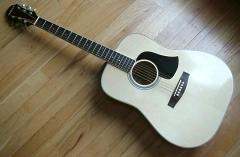
A common six-stringed acoustic guitar.
A guitar is an excellent instrument for almost anyone. A guitar that is difficult to play is not a good choice for a beginner. While it takes dedication to learn, if the guitar is comfortable for the player, it is easier to learn.
Whether you are buying an entry level guitar for yourself or a parent buying a beginner's guitar for a child; it is not worth spending any money on a guitar that the player won't enjoy. How the guitar feels in the player's hands is more important than how it looks hanging up in a store, and the key to learning to play is being excited about playing.
Be careful about buying a guitar for a person that already plays, unless you know exactly what they want. The best course of action is to buy the guitar with the person. Players who have played long enough know what they like and what they don't like. If it is not possible to shop with the guitarist, then the best option is to give them a gift certificate.
Always remember (and this will be obvious after playing a few dozen guitars) every single guitar is different. Even if the guitar is exactly the same make and model and color, it may play completely differently than the next. This is because wood is an organic material and is subject to variation and also the way a shop or manufacturer sets up a guitar may add to the differences. This means in some cases one guitar will be great and another seemingly identical guitar will be a dud.
Retrieved from http://en.wikibooks.org/wiki/Guitar:Buying_a_Guitar
Check these guitars at Guitar Emporium Online
Joe Satriani: Inquirer

Ibanez JS guitars have slowly morphed into such a personal statement of what my hand and my body want to feel, so I guess it’s the guitar.
BEST GUITAR BUYING TIPS #2:
- Alternative: any of the 4 basic types are suitable
- Blues: any of the 4 basic types are suitable
- Bluegrass: acoustic steel string, acoustic/electric
- Classical: acoustic nylon string classic guitar
- Country: acoustic steel string, acoustic/electric, or electric
- Fingerstyle: acoustic, acoustic/electric, classic
- Folk: acoustic, or acoustic/electric
- Folk/Rock: any of the 4 basic types are suitable
- Jazz: any of the 4 basic types are suitable
- Ragtime: acoustic, acoustic/electric
- Rock: usually played on an electric
- Metal: electric
BEST GUITAR BUYING TIPS #1:

There are four basic types of guitar:
* ACOUSTIC - The word means “to hear” and refers to an instrument that can be heard without amplification. Acoustic guitars can have either nylon strings or wound steel strings.
* CLASSIC - One of the oldest types of acoustic guitar. It is designed with a wider neck to facilitate finger-picking techniques.
* ELECTRIC - An instrument that needs to have amplification in order to be heard.
* ACOUSTIC/ELECTRIC - As the name implies, these guitars can be played with or without amplification.
So, just how much should you be prepared to spend? The good news is that it doesn't need to cost you an arm and a leg! You should find that spending somewhere between $100-$300 will be enough to get you started. Of course, be sure to keep in mind as a general rule: the better the instrument, the higher the price.
No guitar? Buy your own guitar now..
It's a lot better if you have a real guitar..
Buy your own guitar now.. Guitar Emporium Online
3 Tips for Better Guitar Playing
Since some famous guitarists have explained that they taught themselves how to play the guitar, everyone seems to think it's an instrument that's fairly easy to learn. That's not the case as some individuals are born with natural talent. Sure some of us could pick up a guitar and start playing our own unique guitar riffs and songs, but what about everyone else? Since there are hundreds of beginner guitarists and guitar playing isn't easy, there are numerous sources one can get help from.
1. Guitar lessons – It could almost be safe to say that there is a guitar instructor for every beginner guitarist. Individuals can find numerous guitar instructors in their community. Some are either private tutors that work at colleges or universities while others are employees that work at guitar shops and record stores. To find out which tutor fits their needs, beginners will have to figure out which styles they prefer. They will also need to consider their expertise, the type of students they work with, their flexibility with your schedule and their course fees.
2. Guitar videos – Instead of taking lessons from instructors, beginners can also learn through videos. Whether they watch them on their television or on a computer, beginners can learn different techniques such as hand position, strumming, finger exercises and rhythm and timing. Guitar videos can be a great tool because they essentially become a mirror an individual in guitar playing as they mimic what they're watching on screen. Visual learners will benefit the most from videos especially if they show some commitment and determination.
3. Guitar theory – One of the best ways to understand how to play guitar is to understand guitar theory. By learning different minor and major chord progressions, chord patterns and note scales, beginners can develop the basic skills every guitarist has. Even though it is harder than learning through videos and instructors, it definitely has its benefits.
Whether beginners learn individually or with a group of friends, understanding the basics of guitar playing can be easy and fun. All it takes is a little bit of determination and guitarists can learn different techniques through lessons, videos and theory. With all the different helpful sources, the road to being a great guitarist can be a short one!
Playing The Guitar
To some, the guitar is simply a stringed musical instrument that is played by strumming or picking the strings they are held down. By holding down the strings in certain combinations, guitarists can play different notes. Most guitars have six strings and are tuned on the scale E A D G B E. To play the guitar, musicians can choose from two different instruments: the electric guitar and the acoustic guitar.
Acoustic guitars have hollow bodies, called sound boxes, which produce a sound that doesn't need amplification. However, some modern ones do come with the electronic hook-ups so that it can be connected to an amplifier if the guitarist chooses to do so. On the other hand, the body of an electric guitar is solid and only semi-hollow and has to be connected to an amplifier to emit sound.
When one learns to play guitar, they should make sure to learn more about guitar tabs and sheet music. Guitar tabs can be very useful when someone decides to play the guitar because they can let individuals learn their favorite songs! Tabs of popular songs can either be found in specialized books or through Internet search engines and websites.
The guitar is used to play almost any kind of music, and because of that it has become extremely popular over the last couple decades. Numerous people try to play the guitar everyday and that's because a brilliant hobby to pick up and continue with for the rest of your life.
Start Off With Easy Guitar Songs and Lessons
When a beginner first starts to learn to play guitar, they should start off with easy guitar songs to practice with. The average beginner will probably not be able to play “Stairway To Heaven” by Led Zeppelin or “Free Bird” by Lynyrd Skynyrd when they first start, so the best thing to do would be to find a few easy guitar songs they like. By starting with some easy songs, beginners will set themselves up for a much quicker learning curve and will be able to pick up guitar skills a lot faster.
For those that prefer in-person lessons, there are several different individuals that can help. Almost every community has guitar tutors and teachers and through some fun lessons, beginners can learn the easy guitar songs they know and love. Even though everyone has different tastes in music, the up-close experience can be worthwhile.
Beginners can also find guitar songs through the Internet. With several different websites dedicated to learning how to play the guitar, the Internet can be much more effective than books. Websites such as Ultimate Guitar and 911 Tabs have extensive collections of guitar tabs categorized by artist, album, genre and difficulty. There are also numerous sections that provide musicians with easy guitar songs they can practice on.
Any beginner guitarist can learn any song; it just takes a lot of practice and effort to learn the more difficult ones. To get such experience, individuals have to start off with easy guitar songs so they can build up to more difficult ones. Since most of the songs are popular favorites, the learning experience can be a great adventure as it can take a guitarist from one level to the next.
4 Guitar Tips to Help You Play Better
The following are a few tips that can help turn a guitarist into an even better one:
1. Make sure you have good posture; by sitting up straight, not only will musicians protect their back but they will also be able to hold the guitar properly while playing. Good posture is a thing everyone is taught when they're young and it can really pay off when it a guitarist is playing in front of spectators.
2. Choose the right pick for you; even though picks come in a variety of styles, most guitarists usually use a flat one. They also come in three different levels of flexibility. By using the softest, flimsiest pick, guitarists will be able to keep up with fast strumming as it's easier on the arm. Flabby picks are harder to use but they can helpful when picking individual guitar strings or flat-picking.
3. Make sure you're holding the pick the right way; if a guitarist doesn't hold the pick firmly enough, they may lose it while they're strumming in a fast and vigorous motion. If they also grip it too tightly, they may find that their arm will get tired faster. This guitar tip may seem useless but it can help a guitarist from messing up a live set or hurting their muscles.
4. Learn to play arpeggios; another useful tip is to learn this technique because it's ideal for folk songs and it gives off a rich sound. The only problem for some is that you have to fingerpick chords instead of using a guitar pick.
Many other guitar tips can also be found through books and the Internet. There are numerous articles out there that are written by professionals and amateurs alike and they can be very useful for beginner guitarists.
Sure most beginners try to learn to play the guitar on their own, but they will always find themselves looking at resources for guitar tricks and tips. This is because playing the guitar is a difficult task and it requires a lot of knowledge to be good at it. With endless collections of guitar tips out there, the road to being a great guitarist can be a short and enjoyable one.
Check these signature guitars at Guitar Emporium Online
4 Tips On How to Read Guitar Music
1. Find the right material; most guitar books will have some basic sheet music in the front pages. These are designed to help individuals read music quickly. Once a beginner has the basic guitar knowledge, it does become relatively easy to learn how to read music sheets. Guitarists should start in small sections, one chord at a time and use their guitar to play the chord out loud until they know that sounds correct.
2. Set yourself up; in order to understand guitar music sheets, beginners will have to make sure they are situated in a room where they won't be distracted. The only way a guitarist will know when they get the sound right is if they are in a room that doesn't contain any loud or sudden distractions. Concentration is the key and isolating yourself will make it easier to learn how to read music.
3. Get started; when free of distractions, beginners should get started by finding a book with guitar music sheets. The best thing to do would be to pick something that's easy and familiar. Knowing a tune makes it that much easier to learn to read music sheets. Beginners should also make sure they are confident with one song before they move onto the next.
4. Continue practicing; by practicing over and over, beginner guitarists will find that they are starting to get better. The best thing individuals should keep in mind is that they will generally apply more time to something when they enjoy it. Trying to learn how to read guitar music can be easy, as long as beginners keep practicing!
One of the main reasons why individuals don't try to read guitar music is because they think it's beyond difficult. But by taking certain steps, it can be easy. Once beginners have mastered the art of reading music, they can then attempt to write their own music which is a gift in itself as it classifies the great musicians from the average ones.
Check these signature guitars at Guitar Emporium Online
How to Buy Your First Guitar
- Determine your budget. As a beginner, try to keep your budget low. Around $200-$300 for any guitar. Used guitars are great as well, so check your local pawn shops and used dealers. Just because the guitar is expensive does not mean it is a good guitar, but also beware of guitars that are under $150, as some may be cheaply made.
- Research. Find someone close to you that has played guitar for a while. Ask them what brands and types of guitars to look for and which to avoid. For example, Fender, Taylor, Martin, and Gibson are very well-known high quality brands.
- Decide if you are going to play an acoustic guitar or an electric guitar. It depends on the style you play.
- Shop. Have your guitar-playing friend go with you to several shops and stores to help you. As a beginner, your ear may not recognize subtle tone qualities that your friend will pick up and help you. This is probably one of the most important things you can do.
- Ask the clerk. Get a pick and a strap from the sales representative and ask him to show you guitars at the higher end of your price range.
- Have the clerk verify that the guitar is tuned to concert pitch or standard tuning. This will allow you to better compare this guitar with others.
- Feel. Try several guitars sitting and standing. If they don't seem natural to you, even slightly, they might be wrong for you. Try several guitars until you find one that feels good in your hands and on your body.
- Place your index finger directly behind the first fret on the fattest string (E6). The fret is the raised metal "line". Pluck the string with a decent amount of force. Listen for buzzes, pops, or odd noises. Check behind each fret on each string using a hard pressure. If you notice even the slightest bit of "non musical" noise, ask the salesman to adjust and re-tune the guitar. Check the guitar again, if the problem persists, don't get that guitar.
- Judge each guitar by feel, sound, and appeal.
- When purchasing: ask for a warranty, a new set of strings, a gig bag, and a tuner. As a new guitarist, you WILL need a gig bag and tuner, so it is wise to buy one. Most dealers leave the factory strings on the guitars for years, robbing them of bright tone, new strings resolve the problem nicely.
- If possible, try to get private guitar lessons. While books are great, they cannot teach you correct technique (the precise way to position fingers, hands, arms, back, and playing), only theory. If private lessons are not available, or are out of your price range, books can suffice.
- Check these signature guitars at Guitar Emporium Online
Things to keep in mind before buying a guitar.
A few things to keep in mind before we begin:
- Have patience- do not decide you HAVE to buy the guitar that day. Plan on taking at least two trips to the music store.
- Maintain control- You are in charge! Don't let music store salesmen intimidate you.
- Research- The web is a great place to find info on guitars. Use it to your advantage!
- Get help- if at all possible, recruit a friend who plays guitar to help you choose an instrument. If not, don't be afraid to ask music store employees multiple questions.
Check these signature guitars at Guitar Emporium Online
Why Sharps and Flats are so important?
Fender Stratocaster History
Types of Guitars
Popular Types of Guitars
Acoustic guitar is independent of any external device to be heard. The acoustic guitar is more sober than other instruments commonly found in bands and orchestras. To play within such groups the sound is often externally amplified. Acoustic guitars, which are available today, feature a variety of pickups. This enables the player to increase and adjust the raw guitar sound.
Prominent subcategories feature within the acoustic guitar group
Classical and flamenco guitars; steel string guitars, that comprise the folk or flat top guitar; arch top guitar and the twelve string guitars. There are unamplified guitars also in the acoustic guitar group.
Such types are designed to play in various registers such as the acoustic bass guitar. The tuning of the acoustic bass guitar is similar to that of the electric bass guitar.
Check these guitars at Guitar Emporium Online
How is a guitar constructed?
1. The guitar's body is the large wooden part of the guitar.
2. The thin part of the guitar that is connected to the body of the guitar is called the neck.
3. The bridge is located on the body of the guitar near the hole.
4. The strings of the guitar begin at the bridge and end at the pegs, which is located on the head of the guitar.
5. The head of the guitar is on the end of the neck not connected to the body.
6. There are small metal pieces located at various intervals along the neck of the guitar. These metal pieces are called the frets. When the player presses the strings into the frets at various intervals, the strings vibrate and produce different pitches.
The way you hold the guitar differs for nearly every type of song you play on a guitar. If you are right handed, your right hand is your strumming hand. Thus, you hold your guitar so that your right hand rests on the strings of the guitar above the hole. This means that your left hand is your picking hand, and your left hand should rest on the neck of the guitar. If you are left handed, then you should use these directions as well, only reversed.
Take time to learn the guitar basics and you will be richly rewarded not only with money, but also with a life long relationship with a wonderful instrument.
Electric guitars
Acoustic Bass
Archtop


